2025 Year in the Rearview

It’s been a fun and eventful year in writing for this author:

  • A year ago, I challenged myself to write at least one blog post a month on average in 2025. This post is my 18th for the year. Mission accomplished!
  • In response to a challenge by my husband, I wrote eight horror comedy short stories. Two of them—Kitty’s Hobby and Armed—got published, and a third , “Food Baby,” will be part of an anthology next year. (One of my dreams is to publish a collection of my horror comedies, because I came up with the best title EVER, which I am keeping secret until I make it happen!)
  • I won third place in the NYC Midnight 100-word Microfiction Challenge 2025. This was thrilling for many reasons, including beating out 4,300+ competitors, the cash prize, and the accomplishment of finally placing in a contest I’ve entered dozens of times without making it into the top 10.
  • Speaking of NYC Midnight, I entered their inaugural Scary Story Challenge, which was great fun despite its unusual 400-word limit. I liked my story so much that I’ve already revised it into a slightly longer 500-word piece that made it onto a shortlist for Dark Holme’s monthly Dark Descent contest.
  • My short story Break Time got published after being rejected 19 times over the years. I thought that story would never find a home. It’s an odd one, and I’m glad it resonated with the folks at Whisper House Press.
  • My story The Window-Room, based on a family ghost story, appeared in the June issue of parABnormal Magazine.
  • My creepy mannequin story Andie appeared in the anthology Weird Tales to Haunt Your Reptilian Brain from Burial Books.
  • My gothic horror story The Painted Man appeared in Pretend You Don’t See Her from Kandisha Press. The book got a very nice review on Horror Tree.
  • I established my very own GoodReads author page and made my first-ever FM radio appearance.
  • And finally, what might be my favorite highlight of the year: my story “The River’s Revenge” was published in Red Line: Chicago Horror Stories. What an honor and a kick it was to appear alongside so many talented Chicago-area authors.

And that’s not all. I’ve written 74,000 words of my first horror novel, the idea for which came to me in a dream earlier this year. While I hoped to be done by year end, it didn’t quite happen, but it will happen soon, because I’m not giving up on this creepy story of isolation and madness.

As much as I’d like to write full-time, I have a day job as well as very full life and people I love. My kids are now 13 and 17. Spending time with them and my husband is my greatest joy. Everyone’s familiar with the feeling of looking back on “the good old days.” For me, the good old days are happening right now, and I wouldn’t trade them for anything. I told Maggie, my oldest, that I had resigned myself to not being done with the draft by the end of 2025. Her response: “So finish it by the end of the Chinese lunar year.” I love that kid.
Generative AI Tools = Sad Beige Prose

Well, it’s 2025, and to my chagrin, generative AI tools have stubbornly refused to go away.

My resistance to large language models is not unique. I’m a creative writer. Obviously I don’t want a dystopian future in which robots write all the novels.

Also, as someone who enjoys writing, it’s hard for me to understand why someone would want a robot to do it for them. There’s no feeling like being in the zone and letting your words flow out onto the page. There’s also no feeling like reading a wonderful piece of someone else’s writing, where you can learn, feel seen, escape your life, and immerse yourself in new worlds.

Gen AI at Work

My day job (I work in web content management at a fortune 500 company) has experimented with gen AI tools, so I’ve had the chance to observe their use in a corporate setting. The tools spit out the most generic, bland, soulless copy you’ve ever read in your life. It’s what my teen and tween kids would call “sad beige” writing. Basically, LLMs process words into the literary equivalent of a hot dog. However, that style is suitable for some types of business writing. Press releases aren’t exactly the place for pithy wit or poetic turns of phrase.

In my limited experience, generative AI tools are neither faster nor better than humans, so they offer no advantage. If I have to spend a bunch of time editing and finessing what the robot writes, I might as well write it myself. That being said, I’ve been writing for years. I’m pretty fast at it. If you aren’t fast, I can see the appeal of having a robot do your first draft.

My biggest concern is “garbage in, garbage out.” People who don’t write typically don’t edit, either. That first draft will be the only draft. Furthermore, if an LLM’s output looks “good enough,” people will come to rely on it and fail to proofread or fact-check it, which can be a huge problem.

Horror and Hallucinations

The internet is as chock-full of ChatGPT horror stories as it is with tech bros claiming ChatGPT is the best thing ever.

When a writer asked ChatGPT to help her research an article, it spat out made-up quotes from historical figures and links to sources about unrelated topics. A lawyer asked ChatGPT to find Arizona case law, and it produced detailed descriptions of cases that did not exist. Two other lawyers used ChatGPT to write a legal brief and got smacked down by a judge in federal court.

My daughter, a 10th grader, told me recently that her pre-calc teacher suggested her students ask ChatGPT to generate some practice problems. “But don’t trust the answers. It gets those wrong,” the teacher said.

And I haven’t even touched on the AI-generated “artwork” that’s the stuff of nightmares.

Does Anyone Publish AI-Generated Work?

AI-generated written material is not protected by U.S. copyright law (though this is evolving; the Copyright Office put out a detailed report just last month). That doesn’t stop people from trying, though. I’ve seen literary agents complain on social media about people querying them with completely AI-generated novels.

Sadly, I see some folks–even writers!–shrug their shoulders and say, “Well, gen AI is here to stay, resistance is futile,” as if it’s an oncoming tsunami and not a choice. It’s been disappointing to see online magazines put statements like these in their submission guidelines:

  • “If we could detect AI-generated content with 100% accuracy, we would not allow it. But since that is not the case, NewMyths will accept AI-generated content if you label it as such.” (NewMyths.com, which published my story Stoneheart in 2021)
  • “If a story is good, it’s good. It shouldn’t matter whether those stories were created with the help of AI, or with a squad of monkeys hammering away at typewriters, or with the help of psychedelic drugs.” (Metastellar)

Thankfully, the vast majority of online magazines have taken a firm anti-AI stance:

In Conclusion

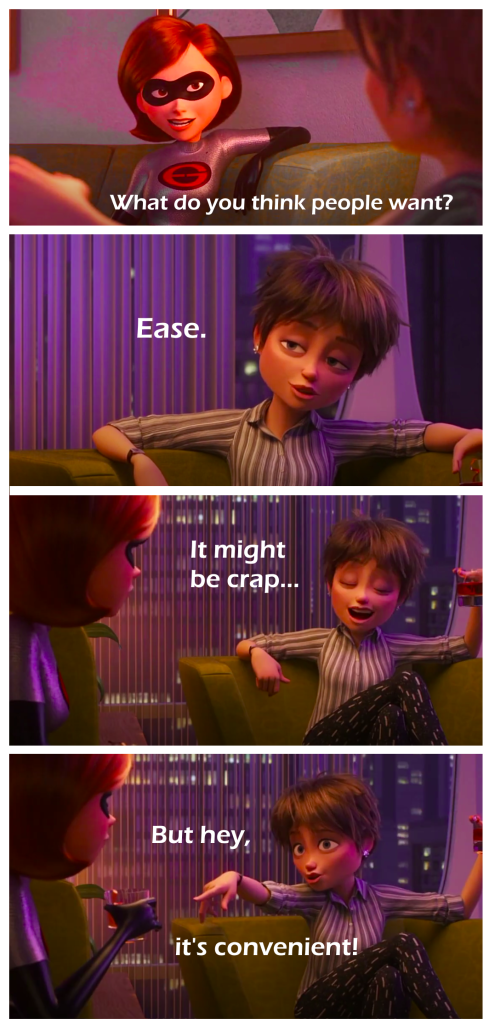
I’ll leave you with food for thought from human writers: two from the world of science fiction, and one from an underrated scene in an underrated movie (Incredibles 2), which is even more poignant if you know which of these characters winds up as the villain.

“Once men turned their thinking over to machines in the hope that this world would set them free. But that only permitted other men with machines to enslave them.” – Frank Herbert, Dune

“Let the world burn through you. Throw the prism light, white hot, on paper.” – Ray Bradbury, Zen in the Art of Writing

🥂 Here’s to More Writing in 2025 🥂

I don’t make New Year’s resolutions. If something is worth saying “I resolve to do this thing!”, then it’s worth doing on whatever day of the year it occurs to you. Declare “I will save money by purchasing fewer Disco Diva costume mods in The Sims” on April 25 and I won’t judge. State “I shall reduce my carbon footprint by recycling my grocery bags into hackey sacks” on September 16 and I’ll cheer you on, dude.

But there’s power in the borders of things, to quote one of Sharyn McCrumb’s characters. The start of a year is an exhilarating time to think about what’s next. It’s a lofty precipice to stand on and contemplate the landscape before making a leap. Plus, if you come out and say that you’ll do something, that makes it happen, like speaking a demon’s name to call it forth.

In that spirit: I’m going to write more this year. I’ve fallen out of my daily habit of writing and I miss it. And I’ll start with something I slacked on last year: blogging. I only posted here 4 times in 2024. Surely I can manage 12 blog posts in 2025. Eleven and a half, really, since I’ve halfway written this one already!

I was quiet here in 2024 partly because I didn’t have much writing news to share. That’s because I spent less time writing and more time querying my novel (which was quite the learning experience but will be its own post).

While writing less, I read more: 23 books (including Stephen King’s The Stand, complete and unabridged, which at 1,149 pages should count as at least two books by itself). That’s a lot of books for a slow reader like me, especially compared with the five books I read in 2023. (Yes, like a true nerd, I track my reads, in a Google doc called “Books Read.” Mostly I do that because, whenever anybody asks me “So, what good books have you read lately?”, my mind goes infuriatingly blank, so I need that doc for reference!)

I did manage to write 11 new short stories last year, and the final quarter of 2024 brought a flurry of happenings:

  • My horror story “The Last Train” came out in Brigid’s Gate Press’s The Horror That Represents You anthology,
  • Three of my microfiction stories entered the world as part of the 42 Stories anthology (and I was the Story of Excellence award winner for the Myth chapter),
  • I signed a contract for “Andie,” a horror flash story, which will be published later this year by Burial Books,
  • My story “The Painted Man” got accepted as a reprint by Kandisha, a woman-owned horror press that I’ve had my eye on for years, and
  • I met for the first time with my Horror Writers Association chapter’s newly formed critique group, a terrific experience that I hope to repeat in 2025.

What are your non-resolutions, readers and writers?

Blog at WordPress.com.

Up ↑