I’m delighted to be working with From Beyond Press and to share this table of contents with 19 amazing authors. All of us either live in Chicago, live in the surrounding counties/suburbs, or grew up here. The city’s energy, sounds, smells, neighborhoods, legends, and history infuse every page of these tales.
Want a taste? Check out my interview below with Al Julius. At 0:24 I read an excerpt from my story “The River’s Revenge.”
I’m very excited to join 5 other speculative fiction authors on August 21 for Strong Women, Strange Worlds’ Third Thursday QuickReads event.
We have 8 minutes apiece. I’ll be reading from my story “The River’s Revenge,” which comes out next week as part of the anthology Red Line: Chicago Horror Stories.
I love a good creepy mannequin story (and really, who doesn’t?). So, last year, when I got these as my prompts in the NYC Midnight Flash Fiction writing contest, I cackled with delight:
GENRE: Horror LOCATION: A tree house OBJECT: A mannequin
In my early 20s, I worked for a consulting firm that served companies operating around the clock. Factories, hospitals, trucking, logistics—anyone running an overnight shift. It was a niche business. For four years, I lived and breathed circadian rhythms and shift schedules. To this day, I retain a fascination with night shifts. The quiet pre-dawn hours, the 3 A.M. dinner breaks, the camaraderie of working an upside-down schedule, keeping things running while most people sleep.
From that background came “Break Time,” a tale of strange happenings during an otherwise routine night shift at a warehouse. Though one of the characters meets a tragic fate, the atmosphere was just as important to me as the plot. Some of my favorite horror stories involve ordinary settings with regular people where something’s “off” just enough to be creepy and unsettling. I hope I’ve managed to hit that note here.
Read Break Time, Whisper House Press’s featured story for August 2025.
And stay tuned for lots more short story news this month!
I have a new story out in the world. “The Window-Room” appears in the June 2025 issue of parABnormal Magazine (Hiraeth Publishing). Unlike many of my stories, this one is personal. It’s a fictionalized version of a family ghost story.
Here’s the facts. My mother’s Aunt Marie wasn’t really her aunt. Marie was a cousin, but she had been raised as my grandmother’s sister. Why? Because Marie’s own mother had died in the 1917-1919 influenza pandemic, leaving behind six children, including three-year-old Marie and a baby girl. Nobody’s sure why Marie went to live with her cousins while her five siblings stayed with their father (who remarried). Everyone involved has passed, and we’ll never know what secrets they took to their graves.
But of course there’s more to the story.
When Marie’s mom died of influenza, her sister and mother called the Italian undertaker. Brooklyn was chock-full of Italian immigrants in 1919, but there was only one undertaker that the family trusted. Maybe it was because he spoke Italian, or perhaps he was a friend. In any case, he only visited their neighborhood once a week.
The dead woman’s mother and sister sat in a room with the baby girl, discussing their dilemma: Should give the baby to the undertaker along with her mother? The baby was alive, but she was sick with the influenza too, and everyone thought it might only be a matter of time. While they sat talking it over, the cradle flipped, tipping the baby out (unharmed) onto the floor. Nobody was standing anywhere near the cradle at the time. The women took it as a sign that they should keep the baby and not give her up to certain death.
This is the only story like this that I’ve ever heard in my family. To my knowledge, nobody on that side had a reputation for drama or tall tales. I have no reason to believe they weren’t telling the truth about what happened in that room. Some things are simply beyond our comprehension, too mysterious for us mere mortals to understand.
I asked Mom: “What was her name? Marie’s mother, the one who died?” Mom didn’t know. We asked other family members. They didn’t remember. I looked at the family tree that my mother’s relatives had created on Geni.com years ago. There was a pink rectangle for this mystery mother, but no first name.
Well. Being a mom myself, who’s lived through a pandemic (though a less harsh one than the epidemic 100 years ago), the thought of dying and leaving my young children behind horrifies me, as it must have horrified her. I thought of how she likely suffered in her final days, mental anguish compounding physical pain. If I could do one thing to honor her, it would be to search through records until I found her name.
Days later, after deep dives through steamship passenger manifests, birth records, marriage certificates, cemetery photos, census ledgers (handwritten in cursive, with many names misspelled), and New York City historical websites, I found her.
The evidence was sufficient beyond reasonable doubt, but I needed to be just a little more sure. When she heard the name, Mom nodded. She told me it lined up with naming traditions for daughters at that time, who were often named for grandparents. She called up one of her cousins, Marie’s son. He couldn’t recall his biological grandmother’s name (not terribly surprising, as the only grandmother he had known was his adoptive one). He said, “Mom told it to me once, a long time ago. It sounded real Italian.” My mom told him the name. “Yes!” he said. “That was it!”
I used her real name in this story: Michelina. Most of the rest is my own imagining of how her life might have been. I hope she’s at peace, and that she can somehow see that her children’s children thrive, even if her own view through the window-room has closed.
Protestors outside the president’s rally in Warren, Michigan on April 29, 2025.
A friend recently told me she thinks participating in public protests is a waste of time. I couldn’t disagree more. Here’s why.
Protesting lets you express yourself. Maybe you write, paint, compose music, dance, play guitar, do stand-up comedy, or make TikTok videos. Protesting is a physical way to state: “I will not be silent in the face of atrocities.” Like all creative expression, it has the power to tell others who you are and let them know they are not alone.
Protests encourage community. The energy at a protest is contagious. If you go alone, you leave with new friends (and, likely, plans for future organizing). If you go with friends, you engage in a shared experience that unites you for a cause. If you bring your kids, they gain an understanding that political issues are much larger than just the things their parents say around the dinner table. (Both of my kids complained when I told them I was bringing them along to protests this month. Afterward, they were enthusiastic, and ready to plan their signs for the next protest.)
Have you ever sung in a large group of people? It doesn’t matter if it’s a rock concert where the audience sings along, or a professional symphony chorus belting out Handel’s Messiah. Joining thousands of voices together is unlike anything else. You can feel it. It’s powerful.
Protests make people pay attention. When you march, drivers take notice as traffic gets rerouted around you. When you stand with signs on a street corner and shout, your neighbors see and hear you as they’re running errands. When videos of protests get shared on social media and covered on the news, you’re showing solidarity to people who want to protest but cannot.
Leaders pay attention, too. It might seem as if many in Washington, DC, pay no attention to protestors, but that’s not true. They do notice, and it gets under their skin. If they didn’t care, they wouldn’t spread lies about protestors being paid to show up, and they wouldn’t be introducing bills to criminalize protest. They know we outnumber them. They’ve heard of the French Revolution. Incidentally, I’ve been to quite a few protests in my 40+ years, but not until this month have I seen guillotines featuring prominently on people’s signs.
Unlike many American media companies, foreign media covers American protests. People around the globe saw the April 5 protests on TV, in their newspapers, and on social media. Billions of eyes are on America right now.
Protesting is a way to do something. In turbulent times like the ones we’re living through, we have two choices: do something, or do nothing. Doing nothing encourages doom-scrolling, despair, insomnia, and high blood pressure. Doing something boosts our spirits, satisfies our urge to act, makes us ask how else we can get involved, and gives us a “next right thing” to do, which can pull us out of a funk.
Protesting is a right that we cannot take for granted. Authoritarian governments squash dissent because it’s an effective tool for people to mobilize and send a message. If it weren’t so important, the Founders wouldn’t have written it into our Bill of Rights, into the First Amendment to our Constitution. We must cherish and exercise that right, or we risk losing it.
If you’re ready to speak up, you can join a May Day protest later this week.
I have a new horror story out today, with several more coming over the next few months.
I think you’ll like Kitty, the main character in my new story, Kitty’s Hobby (free to read at Horrific Scribblings). She’s retired, and she keeps a scrapbook of articles on local murders that she takes a particular personal interest in. One thing’s for sure–they all had it coming.
More breaking news: My story “The River’s Revenge” will appear in Red Line: Chicago Horror Stories, coming this August. I’m delighted to be working with From Beyond Press and to share a table of contents with buddies from the Chicago Horror Writers Association!
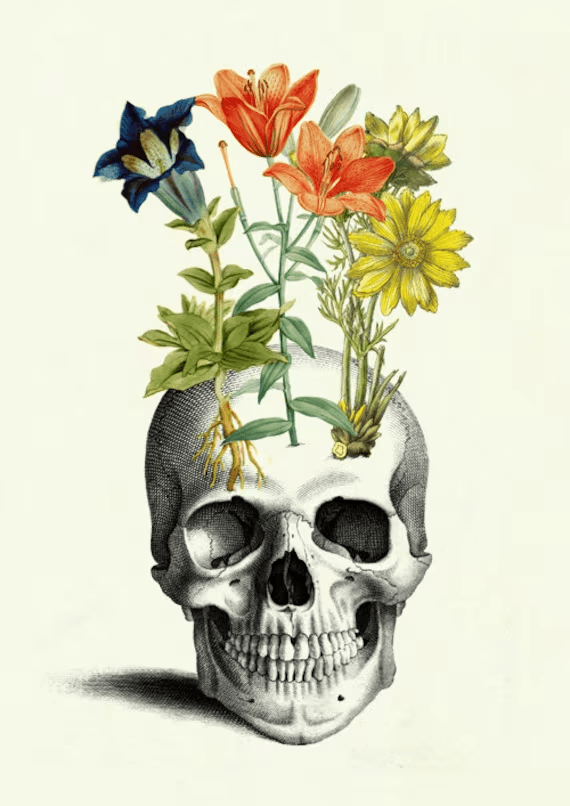
Happy spring, and if you dig up a skull while gardening, put it back and plant those dahlias someplace else. The news is scary enough these days without awakening an ancient curse.
I have a new story out in the world, and it’s free to read. Check out Armed in the March 2025 issue of Humour Me magazine!
You might say it’s a seasonal tale. It begins like this: “I first noticed my phantom arm when it pinched Brandon Stetson on the ass at the St. Patty’s Day parade.”
That line floated into my head one day out of the blue, and just like that, I had my main character and her voice. Sometimes, first lines can be tricky to come up with. Other times, one of them shoots out of the stratosphere and hits you in the face like a sunbeam. That was the case this time.
Hey, the muse does what she wants, ya know? In ancient Greece, the Muses were demure toga-draped goddesses holding lyres and scrolls. My muse is more like a hobgoblin with ADHD who pops up to ambush me during idle moments (and sometimes in the middle of meetings) with story ideas, scenes, and bits of dialogue. I wouldn’t trade her.
Well, it’s 2025, and to my chagrin, generative AI tools have stubbornly refused to go away.
My resistance to large language models is not unique. I’m a creative writer. Obviously I don’t want a dystopian future in which robots write all the novels.
Also, as someone who enjoys writing, it’s hard for me to understand why someone would want a robot to do it for them. There’s no feeling like being in the zone and letting your words flow out onto the page. There’s also no feeling like reading a wonderful piece of someone else’s writing, where you can learn, feel seen, escape your life, and immerse yourself in new worlds.
Gen AI at Work
My day job (I work in web content management at a fortune 500 company) has experimented with gen AI tools, so I’ve had the chance to observe their use in a corporate setting. The tools spit out the most generic, bland, soulless copy you’ve ever read in your life. It’s what my teen and tween kids would call “sad beige” writing. Basically, LLMs process words into the literary equivalent of a hot dog. However, that style is suitable for some types of business writing. Press releases aren’t exactly the place for pithy wit or poetic turns of phrase.
In my limited experience, generative AI tools are neither faster nor better than humans, so they offer no advantage. If I have to spend a bunch of time editing and finessing what the robot writes, I might as well write it myself. That being said, I’ve been writing for years. I’m pretty fast at it. If you aren’t fast, I can see the appeal of having a robot do your first draft.
My biggest concern is “garbage in, garbage out.” People who don’t write typically don’t edit, either. That first draft will be the only draft. Furthermore, if an LLM’s output looks “good enough,” people will come to rely on it and fail to proofread or fact-check it, which can be a huge problem.
Horror and Hallucinations
The internet is as chock-full of ChatGPT horror stories as it is with tech bros claiming ChatGPT is the best thing ever.
My daughter, a 10th grader, told me recently that her pre-calc teacher suggested her students ask ChatGPT to generate some practice problems. “But don’t trust the answers. It gets those wrong,” the teacher said.
And I haven’t even touched on the AI-generated “artwork” that’s the stuff of nightmares.
Does Anyone Publish AI-Generated Work?
AI-generated written material is not protected by U.S. copyright law (though this is evolving; the Copyright Office put out a detailed report just last month). That doesn’t stop people from trying, though. I’ve seen literary agents complain on social media about people querying them with completely AI-generated novels.
Sadly, I see some folks–even writers!–shrug their shoulders and say, “Well, gen AI is here to stay, resistance is futile,” as if it’s an oncoming tsunami and not a choice. It’s been disappointing to see online magazines put statements like these in their submission guidelines:
“If we could detect AI-generated content with 100% accuracy, we would not allow it. But since that is not the case, NewMyths will accept AI-generated content if you label it as such.” (NewMyths.com, which published my story Stoneheart in 2021)
“If a story is good, it’s good. It shouldn’t matter whether those stories were created with the help of AI, or with a squad of monkeys hammering away at typewriters, or with the help of psychedelic drugs.” (Metastellar)
Thankfully, the vast majority of online magazines have taken a firm anti-AI stance:
“We are not interested in AI-generated fiction.” (Fantasy Magazine)
“We do not accept stories written by AI tools such as Chat GPT. If you submit such stories, we may ban you from submitting.” (Flash Fiction Magazine)
“NO AI. People using AI to cobble together stories are not welcome; just go away, nobody likes you.” (Unnerving Magazine)
In Conclusion
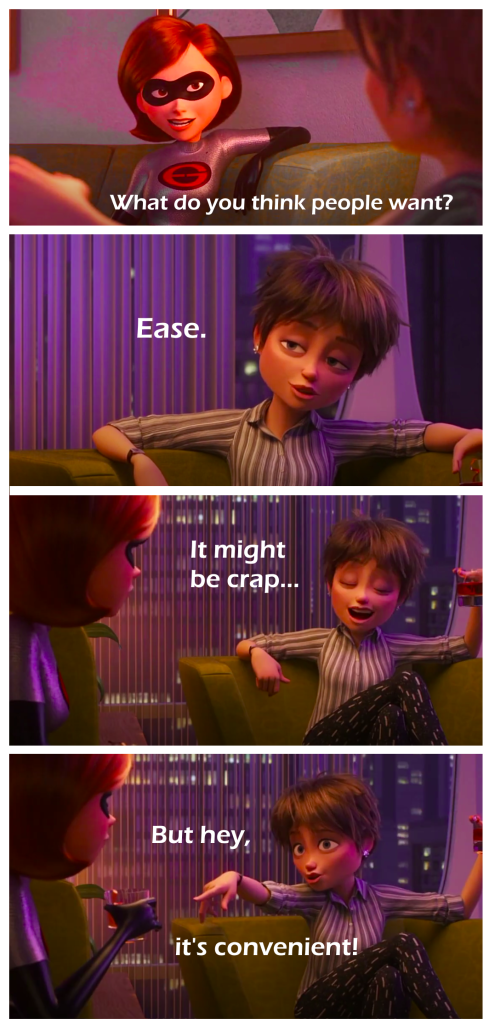
I’ll leave you with food for thought from human writers: two from the world of science fiction, and one from an underrated scene in an underrated movie (Incredibles 2), which is even more poignant if you know which of these characters winds up as the villain.
“Once men turned their thinking over to machines in the hope that this world would set them free. But that only permitted other men with machines to enslave them.” – Frank Herbert, Dune
“Let the world burn through you. Throw the prism light, white hot, on paper.” – Ray Bradbury, Zen in the Art of Writing
I don’t make New Year’s resolutions. If something is worth saying “I resolve to do this thing!”, then it’s worth doing on whatever day of the year it occurs to you. Declare “I will save money by purchasing fewer Disco Diva costume mods in The Sims” on April 25 and I won’t judge. State “I shall reduce my carbon footprint by recycling my grocery bags into hackey sacks” on September 16 and I’ll cheer you on, dude.
But there’s power in the borders of things, to quote one of Sharyn McCrumb’s characters. The start of a year is an exhilarating time to think about what’s next. It’s a lofty precipice to stand on and contemplate the landscape before making a leap. Plus, if you come out and say that you’ll do something, that makes it happen, like speaking a demon’s name to call it forth.
In that spirit: I’m going to write more this year. I’ve fallen out of my daily habit of writing and I miss it. And I’ll start with something I slacked on last year: blogging. I only posted here 4 times in 2024. Surely I can manage 12 blog posts in 2025. Eleven and a half, really, since I’ve halfway written this one already!
I was quiet here in 2024 partly because I didn’t have much writing news to share. That’s because I spent less time writing and more time querying my novel (which was quite the learning experience but will be its own post).
While writing less, I read more: 23 books (including Stephen King’s The Stand, complete and unabridged, which at 1,149 pages should count as at least two books by itself). That’s a lot of books for a slow reader like me, especially compared with the five books I read in 2023. (Yes, like a true nerd, I track my reads, in a Google doc called “Books Read.” Mostly I do that because, whenever anybody asks me “So, what good books have you read lately?”, my mind goes infuriatingly blank, so I need that doc for reference!)
I did manage to write 11 new short stories last year, and the final quarter of 2024 brought a flurry of happenings:
Three of my microfiction stories entered the world as part of the 42 Stories anthology (and I was the Story of Excellence award winner for the Myth chapter),
I signed a contract for “Andie,” a horror flash story, which will be published later this year by Burial Books,
My story “The Painted Man” got accepted as a reprint by Kandisha, a woman-owned horror press that I’ve had my eye on for years, and
I met for the first time with my Horror Writers Association chapter’s newly formed critique group, a terrific experience that I hope to repeat in 2025.
What are your non-resolutions, readers and writers?



 Writing by Jen Mierisch