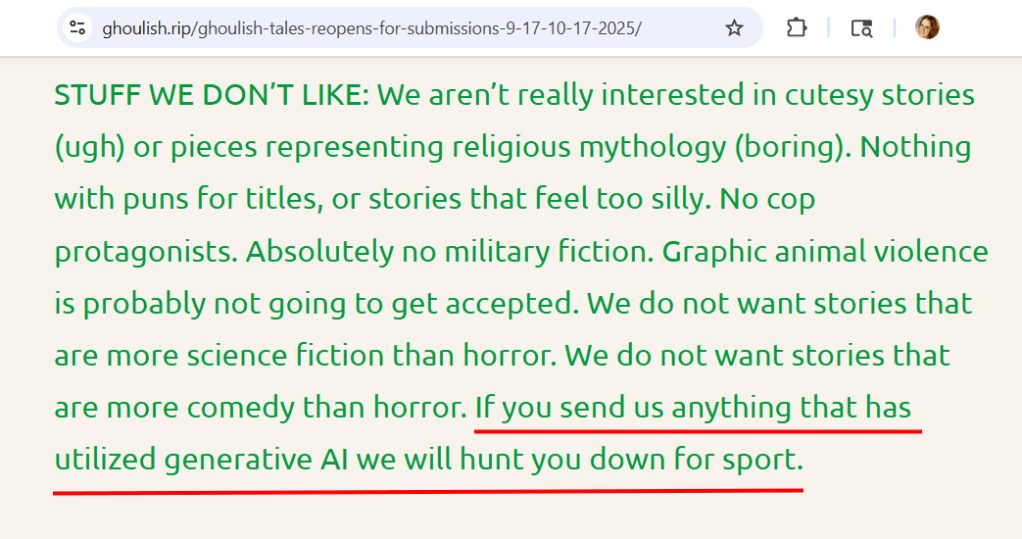
It should surprise nobody that creative writers, and most publishers, aren’t fond of the use of generative AI to create fiction. We got into this because we love writing, not because we wanted to outsource it to robots. We tend to be vocal in our distaste, sometimes strident, often colorful, because we are artists, not purveyors of sad beige prose.
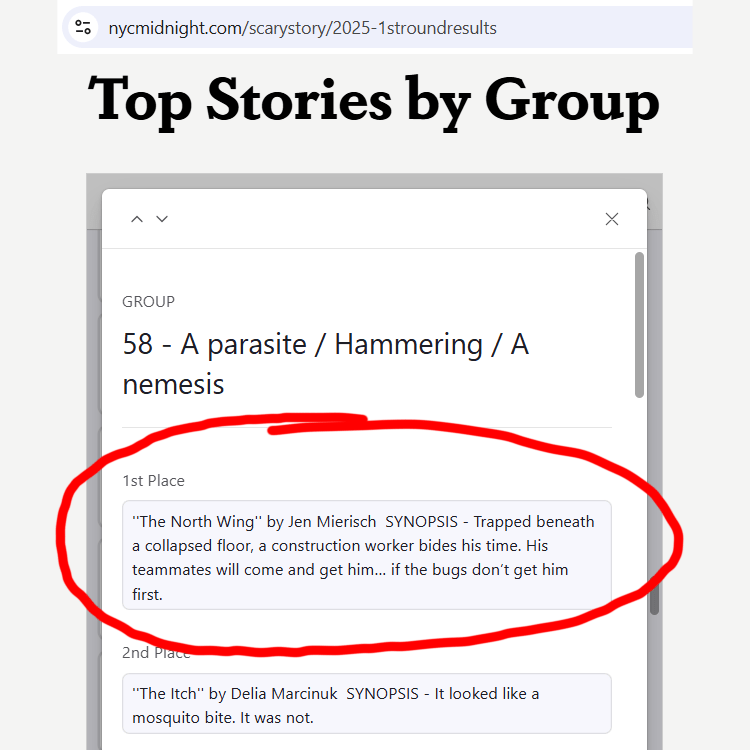
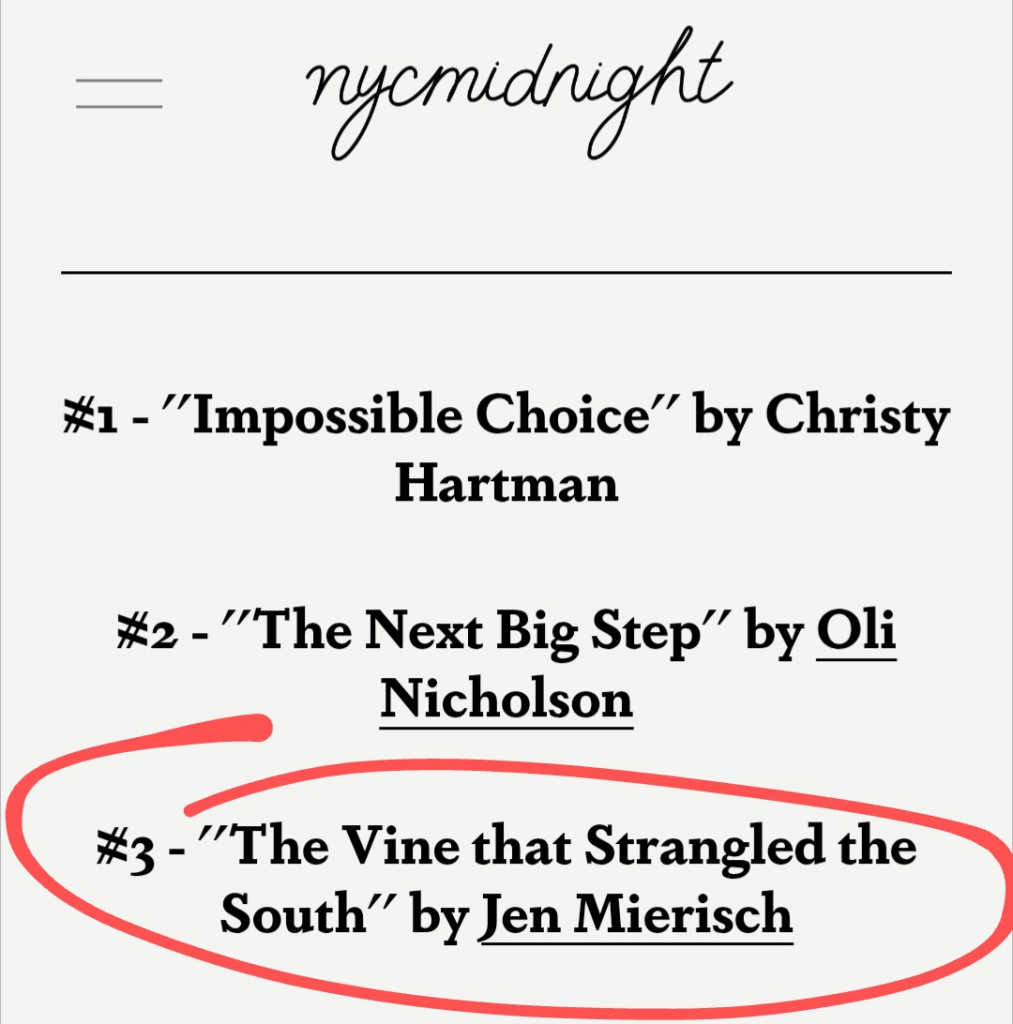
Now that’s a way to start the new year off right! Thank you, NYC Midnight judges, for ranking me first in my group in the Scary Story Challenge. I’m glad my bug story creeped you out. And I’m certain that’s not a beetle that you feel crawling up your leg. Just a stray hair, surely.
This result is from Round 1 of a 3-round contest. If you’re looking for writing competitions with good prompts to get your started, I highly recommend NYC Midnight, which also runs contests for screenplays, short stories, rhyming stories, and microfiction.
It’s been a fun and eventful year in writing for this author:
A year ago, I challenged myself to write at least one blog post a month on average in 2025. This post is my 18th for the year. Mission accomplished!
In response to a challenge by my husband, I wrote eight horror comedy short stories. Two of them—Kitty’s Hobby and Armed—got published, and a third , “Food Baby,” will be part of an anthology next year. (One of my dreams is to publish a collection of my horror comedies, because I came up with the best title EVER, which I am keeping secret until I make it happen!)
I won third place in the NYC Midnight 100-word Microfiction Challenge 2025. This was thrilling for many reasons, including beating out 4,300+ competitors, the cash prize, and the accomplishment of finally placing in a contest I’ve entered dozens of times without making it into the top 10.
Speaking of NYC Midnight, I entered their inaugural Scary Story Challenge, which was great fun despite its unusual 400-word limit. I liked my story so much that I’ve already revised it into a slightly longer 500-word piece that made it onto a shortlist for Dark Holme’s monthly Dark Descent contest.
My short story Break Time got published after being rejected 19 times over the years. I thought that story would never find a home. It’s an odd one, and I’m glad it resonated with the folks at Whisper House Press.
My story The Window-Room, based on a family ghost story, appeared in the June issue of parABnormal Magazine.
My creepy mannequin story Andie appeared in the anthology Weird Tales to Haunt Your Reptilian Brain from Burial Books.
My gothic horror story The Painted Man appeared in Pretend You Don’t See Her from Kandisha Press. The book got a very nice review on Horror Tree.
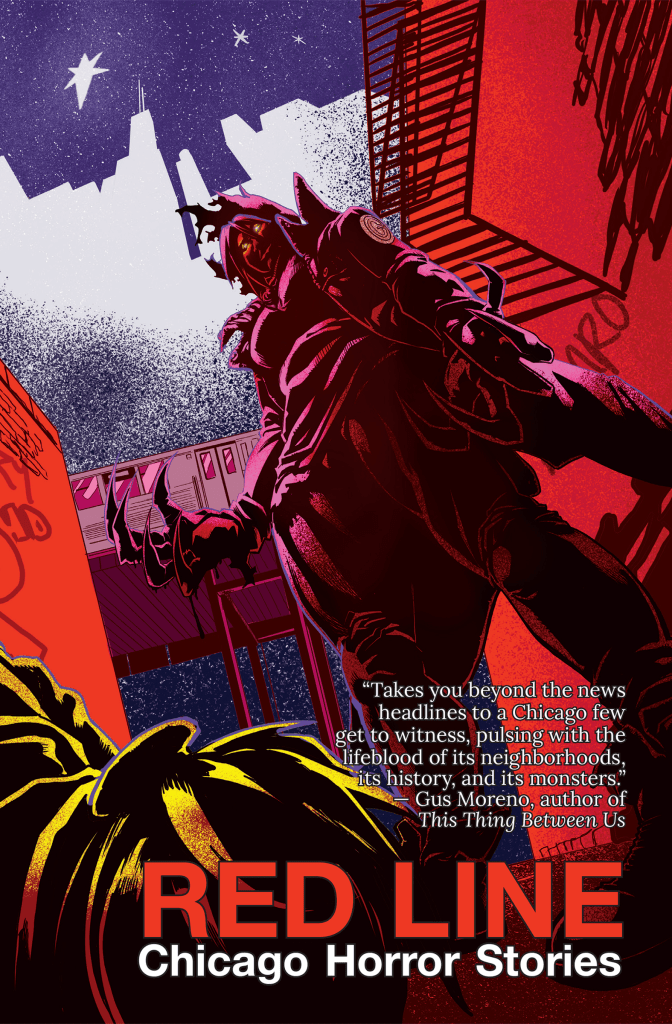
And finally, what might be my favorite highlight of the year: my story “The River’s Revenge” was published in Red Line: Chicago Horror Stories. What an honor and a kick it was to appear alongside so many talented Chicago-area authors.
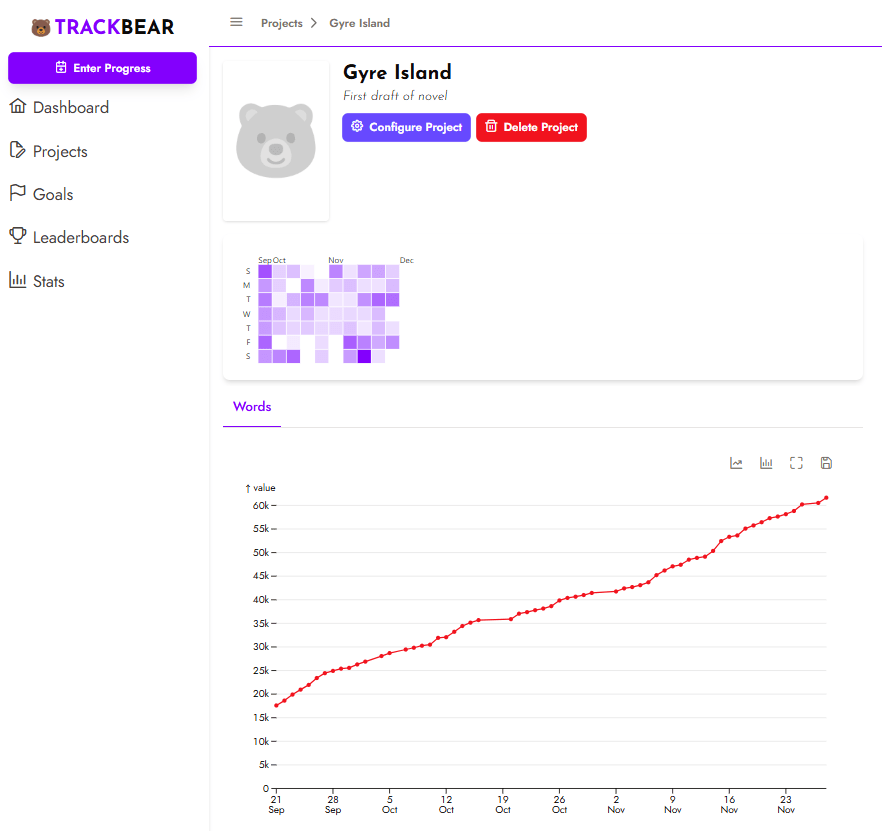
And that’s not all. I’ve written 74,000 words of my first horror novel, the idea for which came to me in a dream earlier this year. While I hoped to be done by year end, it didn’t quite happen, but it will happen soon, because I’m not giving up on this creepy story of isolation and madness.
As much as I’d like to write full-time, I have a day job as well as very full life and people I love. My kids are now 13 and 17. Spending time with them and my husband is my greatest joy. Everyone’s familiar with the feeling of looking back on “the good old days.” For me, the good old days are happening right now, and I wouldn’t trade them for anything. I told Maggie, my oldest, that I had resigned myself to not being done with the draft by the end of 2025. Her response: “So finish it by the end of the Chinese lunar year.” I love that kid.
Many writers, myself included, have mixed feelings about the demise of the National Novel Writing Month website, nanowrimo.org. (To read about why it went kaput, visit nanoscandal.com.)
NaNoWriMo motivated thousands of us to challenge ourselves and write 50,000 words or more in a single month. It was NaNoWriMo (and the writers who encouraged me to go for it – shout out to J.D. Blackrose) that made me realize I had it in me to write a novel-length work at all, when I’d previously written only blogs and short stories.
One of my favorite things about NaNoWriMo was that you could use its website to chart your progress, and it would create a pretty graph for you. Perhaps I am a simple creature, but seeing that line trending upward was super motivating to me.
The good news: other sites have sprung up to fill the gap NaNoWriMo left behind. My favorite is TrackBear, which I’ve been using since September to track my latest novel-in-progress.
Over the weekend, I had the pleasure of appearing on my friend Sue Edelman’s radio show, “Something About the Women,” the longest-running women’s music radio show in the United States, on WMFO (91.5 FM, Medford, Massachusetts).
We chatted about my recently published story “The River’s Revenge” (RED LINE: Chicago Horror Stories, From Beyond Press, 2025) and I picked out a spooky set of tunes to accompany our chat. It was a lot of fun. Thanks Sue and WMFO for the opportunity to haunt your airwaves.
My day job is at a Fortune 100 company (you’ve definitely heard of it). I’m on the enterprise digital team, working on the company’s websites and other online products.
The company has made AI tools available to us: Microsoft Copilot and a handful of others. At first, it was “Use these tools where it makes sense.” Then it was “Look for opportunities to use these in your work.” Today, they told us we must all take 5 hours’ worth of AI training classes and earn a badge by the end of the year.
I have no complaints about the required training. I enjoy learning and I’m interested in how AI is evolving. That being said, I haven’t been using the AI tools much. If they helped me do things faster or better, I might use them. For my role, they do not.
Our use of these tools seems to be sliding from voluntary to mandatory, and that leaves a bad taste in my mouth. Why? Because generative AI tools were trained on authors’ work without permission, compensation, or attribution, and I am one of those authors. (If you want to find out if your own work was used, visit The Atlantic’s search tool.) I wrote about GenAI’s sad beige prose back in February. Things have not improved since then.
A quick sidebar. Many of us find generative AI unpalatable, but today I saw resistance from an unexpected source. 404 Media reported that a company called Best Beer introduced an AI tool into a craft beer competition. At a Canadian Brewing Awards event, Best Beer asked judges (who must be certified and really know their stuff) to enter their tasting notes into an AI-powered app, which then generated summaries. The judges were not pleased. “It was taking real human feedback, spitting out crap, and then making the human respond to more crap that it crafted for you,” one judge said. “To strip out all of the humanity from it is a disservice to the industry,” said another. A third judge said the introduction of AI was “enshittifying” beer tasting.
AI does not need to be applied to everything just because it exists. The best way I’ve heard it phrased is this: AI is a shiny new hammer, but not everything is a nail. It’s great at summarizing long documents. It’s good at translating and transcribing. But it cannot replicate the human touch. The beer judges agreed, because, like writing and painting, “Brewing is an art.”
I tried to come up with a good metaphor for how it feels to be forced to use tools trained on my own stolen work. My first thought: It’s like being told to eat a bowl of chili that may or may not contain chopped-up bits of your own children. This accurately captured my visceral reaction to having GenAI tools shoved down my throat, but it was a tad dramatic.
My 16-year-old daughter Maggie came up with a better one. She said: “It’s like if you planted a bunch of trees, watered them, grew them for years, and then someone came along and cut off their branches without asking you, then made pencils out of them and asked you to use the pencils.”
Indeed. And that comparison is perfect in a way that no machine could replicate.
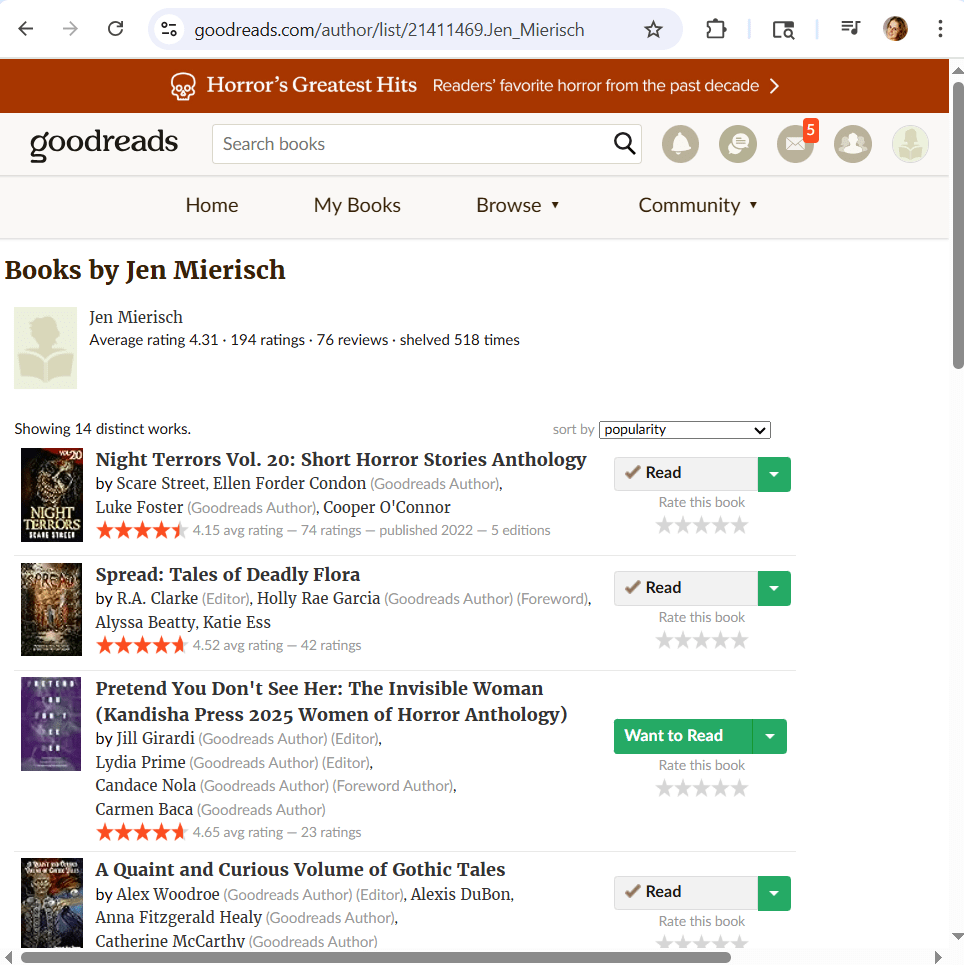
Only a subset of my books are currently listed. I’m working on adding the rest, which is a tricky process for anthologies in which you’re not the sole author.
From Shirley Jackson’s The Haunting of Hill House (1959):
“I need not remind you, I think, that the concept of certain houses as unclean or forbidden–perhaps sacred–is as old as the mind of man. Certainly there are spots which inevitably attach to themselves an atmosphere of holiness and goodness; it might not then be too fanciful to say that some houses are born bad.”
Thus speaks Dr. Montague to the people he’s invited to observe the paranormal goings-on at Hill House, in a book that’s been called by the Guardian “the definitive haunted house story.”
Longtime horror enthusiast that I am, I’d never read The Haunting of Hill House until this summer, nor watched any of the movie and TV adaptations (which, reportedly, are hit or miss). I had only read her creepy short story The Lottery (free to read), which I recommend. I enjoyed Hill House so much I’m rereading it before giving it back to the library. It’s a slow-burn Gothic horror that takes its time unnerving you.
I am the same age–48–that Shirley Jackson was when she died in 1965. Reading her Wikipedia page, I can’t help but identify with her, just as I identified with Eleanor, the awkward, imaginative protagonist of Hill House.
Like me, Jackson was a mother and approached this role with humor, saying of herself and her husband “Our major exports are books and children, both of which we produce in abundance,” writing memoirs about her experiences of parenthood titled Life Among the Savages and Raising Demons. (Horror writers have the best senses of humor, but that’s a topic for another post.) In life, Jackson felt patronized in her role as a “faculty wife” and, even as an adult, endured her mother’s constant criticism about her hair, her weight, and her nonconformist life. Jackson’s work explored themes I’ve often visited in my own stories: madness; being haunted by one’s own past or failures; how women’s sublimated rage can emerge in violence. If we had met, I imagine we would have been friends.
Heart disease killed Jackson. In addition to physical issues (heavy smoking, asthma, colitis), Jackson dealt with severe anxiety and a chronically unfaithful husband whom she felt incapable of divorcing. She had taken drugs (tranquillizers and amphetamines) periodically for various conditions as well as drinking alcohol. And then there’s the toll that raising four children takes on a woman’s body and energy, perhaps unquantifiable, but deeply familiar to every mother.
What else might Jackson have written if she’d had more time? I find her early death as tragic as the protagonist’s fate at the end of The Haunting of Hill House. Ultimately they could not escape past events that damaged and haunted them.
Toward the end of her life, while recovering from a debilitating nervous breakdown, Jackson wrote in her journal:
if i am cured and well and oh glorious alive then my books should be different. who wants to write about anxiety from a place of safety? although i suppose i would never be entirely safe since i cannot completely reconstruct my mind. but what conflict is there to write about then? i keep thinking vaguely about husbands and wives, perhaps in suburbia, but i do not really think this is my kind of thing. perhaps a funny book. a happy book. . . . plots will come flooding when i get the rubbish cleared away from my mind.
There are three morals to this story. One: get your heart checked, especially if you’ve got risk factors. Two: read Shirley Jackson’s work if you haven’t already; I think you’ll like it. And three: if your heart’s desire is to write that story that’s in your soul, start right now, today, because none of us knows how long we’ve got, and no matter how dark your story might be, it’s worth telling.
They sent out the results around midnight, New York time, because they’re called NYC Midnight. Being in Central Time, I’m usually still up at that hour, but it had been a long day.
What a thrill. I’ve been entering NYCM’s contests since 2019: short stories, screenplays, micro, flash, even rhyming stories. The prompts are always a fun challenge (especially never knowing which genre you’ll be assigned; talk about flexing your writer muscles), and the community forums are great. I’ve made it to the finals a handful of times but never placed until now.
The secret to my success? Writing while in the middle of doing other things, evidently. Of the 3 stories I wrote in the 3 rounds of this contest, I wrote the first at dawn in a hotel room at a waterpark before my kids woke up. The second, I submitted at the 11th hour from a bunk bed in my daughter’s bedroom, where I was sleeping due to house guest arrangements after her school play. And I wrote the last one in the car on the way from Tennessee to Carolina Beach, N.C., while staring out the window at kudzu (shout out to my husband, who drove and let me bounce ideas off him at the same time).
If you’re looking for a contest and you love horror, NYC Midnight is launching its first-ever Scary Story Challenge this October!
This anthology truly has something for everyone: history, madness, murder, time travel, vengeance, local legends, animal attacks, blood, and of course my story “The River’s Revenge,” which I would describe as campy horror with monsters. All stories are set in the city of Chicago and are written by Chicago-area authors.
I couldn’t pick a single favorite story in this book, but here are my top 3:
“Lucky Charms” by Sandra Jackson-Opoku is a delightful time-travel piece that bridges the days of Jean Baptiste Pointe DuSable (for whom Lake Shore Drive was recently renamed) and the modern era.
“All You Are Is Bright and Clear” by Bendi Barrett, a neon-glow nightmare that would make an excellent Black Mirror episode.
“Lives Matter” by Jotham Austin II, which had me side-eyeing birds in my neighborhood for a week.
Reviewer highlights:
“Collectively, Red Line’s contributors create a thrilling mosaic of Chicago—past, present, and future—in all its complex, terrifying beauty. From golden hour on an el platform to the labyrinthine depths of Wacker Drive, familiar settings become unforgettably uncanny in these writers’ hands.” – Emily McClanathan, Chicago Reader
“…a multifaceted abstract of the city’s soul with splashes of ghost stories and sci-fi highlights. In foregrounding the love of Chicago in his collection, Phillips creates a metaphor for loving horror. Disaster, mass murder, genocide, abuse, torture, ghosts… all things one should run from, but horror fans with their love of a good story, cannot look away. Chicago is like that. The stories in this collection aren’t ripped from the headlines, but Phillips’ selection of stories uses Chicago’s grittiness to create a tragically flawed protagonist that readers will love.” – Randy Hardwick, Chicago Review of Books
“Chicago’s lively neighborhoods, monuments, architectural wonders and colorful residents might be as deadly as they are lovely.” – Donald G. Evans, NewCity Lit


 Writing by Jen Mierisch